Active learning and the data flywheel
Specialist models
Specialist models
can beat generalists.
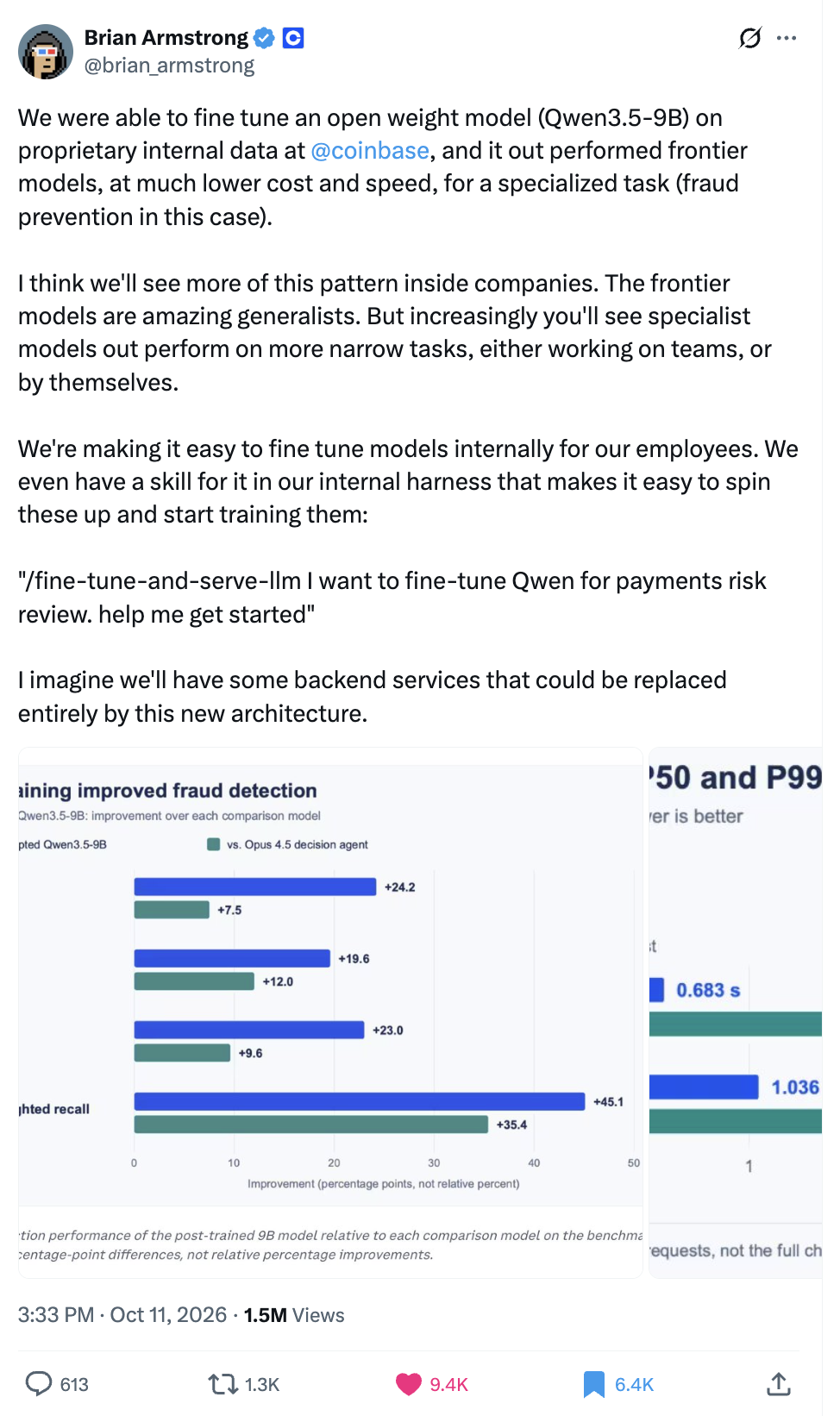
Coinbase fine-tuned Qwen3.5-9B, an open-weight model, on its own data. For fraud prevention, it outperformed frontier models at much lower cost.
Evals and active learning
Short on engineering, but want to train your own model?
Short on engineering, but want to train your own model?
We can help.
RadianVector focuses on optimizing inference for open models. We also build the products around your training loop: evals, datasets and versioning.
You train new versions of your model, and we evaluate each one. We tell you how good it is and how it compares with the model it started from, before you customized it.
- Where the model is goodThe tasks the new version gets right.
- Where it is badThe tasks it gets wrong, with examples.
- Which part needs more workWhere more training data will help most in the next round.
- How it comparesAgainst the model it started from, and other models you could use instead.
Products around your training loop
- Pairwise evalsTwo versions on the same tasks, side by side.
- Stability checksThe same request repeated, to see how often the answer changes.
- Failure miningThe cases your model gets wrong, found and grouped.
- Long vs short contextHow quality holds as the prompt grows.
- Eval datasetsBuilt from your tasks, with checked answers.
- Held-out datasetsKept out of training, to score each version on data it has not seen.
- Model versioningEvery version, with the data that went into it.
- Results versioningEvery score tied to the model version and dataset behind it.
Start a conversationTraining your own model?